

Blog
Insights
Barrel Reduction Strategies: How Wineries Are Using Alternative Oak to Improve Their Economics

Jon Frost explains how hybrid oak programs are helping wineries reduce costs, improve wine consistency, and build more flexible, profitable winemaking strategies.
For generations, oak barrels have been one of the defining tools of premium winemaking. But rising production costs, tighter margins, changing consumer preferences, and increasingly unpredictable vintages are prompting wineries to rethink how they use oak.
Rather than replacing traditional barrels, many wineries are adopting hybrid oak programs that combine traditional barrels with premium alternative oak products. The goal is to improve consistency, maintain wine quality, reduce cellar costs, and create greater flexibility in winemaking. From premium estate wineries to bulk wine and private label producers, oak management has become an increasingly important part of building commercially successful wine styles.
In this exclusive interview with the International Bulk Wine & Spirits Show (IBWSS), Jon Frost shares why wineries are reducing barrel dependence, explains the latest developments in alternative oak, introduces the concept of palate mapping, and discusses how wineries can design oak programs that deliver better quality, greater consistency, and improved economics.
With rising production costs and margin pressure, why are more wineries rethinking their barrel programs today?
The wine industry is facing two major pressure points in escalating operational costs, plus highly selective consumer spending. Traditional barrel programs are capital-intensive, require significant warehouse footprints, demand heavy labor for topping and sanitation, and tie up cash flow for years.
A traditional barrel acts as a blunt instrument. Meaning the traditional barrel fulfills simultaneous needs: adding structure and volume, encouraging or masking fruits, or introducing spice rack aromatics to a wine. But this is without means of adjusting any of these variables up or down. You get what you get. Today, wineries are adjusting to tightening budgets, which leads to the blending limitations a 100% traditional barrel cellar presents, regardless of the tier or quality of program.
Rethinking a barrel program is not about lowering standards or replacing traditional barrels. It is about maximizing the opportunities through intelligent use of high-quality adjuncts, whether that be through bung inserts or tank installations of staves or blocks. Use of adjuncts can free up capital for the most integral traditional barrel profiles for premium projects.
Alternative oak has evolved significantly over the years. What are the biggest misconceptions wineries still have about it?
There are two misconceptions we see in the market today for alternative oak. First is the misconception that alternative oak is simply oak that did not make the grade for barrels. Second is the misconception that the dosage of alternative oak is consistent as applied to barrels.
When we look at the oak tree, it grows relatively straight. However, the oak tree still has subtle turns. There are instances where the oak may not be of appropriate length, maintain density, or be of the correct physical aspects required for a stave destined for barrel production.
Many of these pieces that are parsed out at the cord are still the desired density and contain the exact appreciable compounds that are of stave-grade quality, making them ideal for adjunct production. Once the quality minimums for Nobile are met, we continue to season for at least 24 months, but for the purpose of premium flavor development, rather than for barrel structural integrity.
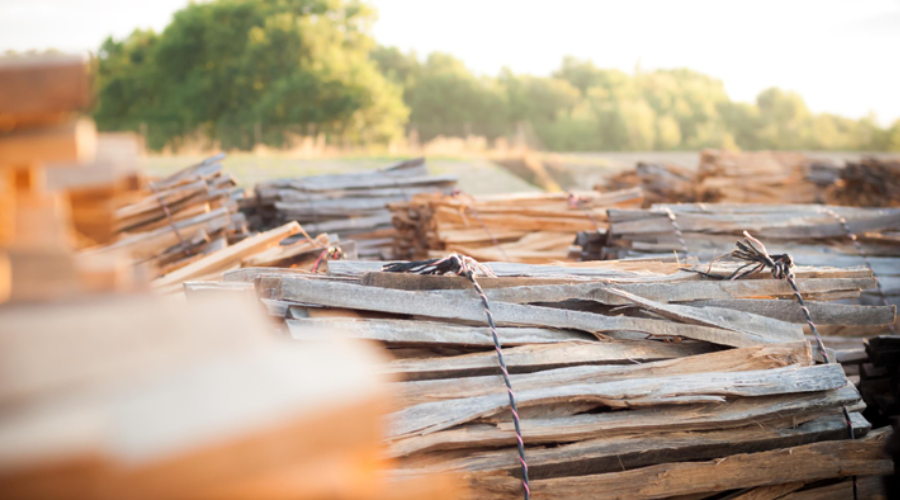
Image: Oak seasoned at least 24 months in Bordeaux.
Looking at the dosage misconception, it is confusing, to say the least. It is by far the most difficult question, as there are many systems used globally. Staves per Hectoliter, Grams per Liter, Square Feet per Gallon, New Barrel Equivalent % (NBE%), and more. Just focusing on NBE% here, I hope to remedy some of this confusion.
It would make sense that if I were applying four new barrels to a lot that required ten barrels, that would be 40% New Oak. However, when applying adjuncts, you would not want 40%NBE.
NBE% is the measurement of the extractable area of the interior of a 225L barrel, but does not consider the impact. If we line up 10 traditional barrels at the same toast levels, would they all provide the same level of impact on the palate? Probably not. While also considering the methods in the way they are toasted, fire or convection, some barrels just have a greater impact than others. Yet all have a comparable interior surface area for extraction in a 225L barrel.
For Nobile Oak, we consider “full strength” equivalency of impact to a traditional new barrel to be around 20%NBE. Many producers consider this closer to 30%NBE, but it comes back to how much impact you are looking for in your wine. We find that at these lower dosages, we can achieve premium quality results and a comparative impact to a traditional barrel.
You mentioned “palate mapping” in winemaking. Can you explain what palate mapping means and how wineries can use it more proactively?
Palate mapping is the practice of matching specific oak chemical compounds to the precise physical geography of where they are perceived in the mouth.
Instead of evaluating oak purely by aroma, we map how it alters the structure, volume, and trajectory of the wine across the palate. Looking at the palate as a three-dimensional model, we can push and pull, widen and narrow, increasing upward and downward pressures at different parts of the palate.
Wineries can use this proactively by identifying structural gaps in their base wine before making an oak purchase. For example:
- If a wine is hollow in the mid-palate but has good length, do not just throw general medium toast oak at it. You can target a solution with a profile designed to tighten and elongate the palate while driving more fruit to the finish, but combined with greater amplitude and body without weight.
- If a wine is too far forward and would benefit from some sweetness, a general medium plus long toast is not quite the answer. You can build a solution with profiles designed to widen the entry and introduce sweetness while narrowing the finish with additional caramel, structurally increasing the overall downward pressure of the rear palate as you shift the focus away from the astringent entry.
These solutions are derived from years of repeated trials conducted with our adjuncts. While every tool may not work perfectly for every wine, we like that we can visualize the profiles to the needs of the winemaker, wine, and program to proactively build a solution.
How can wineries create more repeatable wine styles year after year, especially for bulk wine and private label programs?
Agricultural variances guarantee that vintages vary, but consumers expect consistency from wherever they purchase wine. Achieving repeatability requires deconstructing your target wine style into technical components. If we break down an oak program, we tend to see it in three parts:
- Foundational profiles representing 50%+ of the blend for core structure.
- Heads profiles 20-30% for fruit brightness and freshness
- Aromatic profile 20-30% for spice, vanilla, or sweetness
If a challenging growing season leaves your bulk base wine short on mid-palate weight, you may want to increase your Foundational adjunct component.
If a hot vintage over-ripens the fruit and dulls the aromatics, you can lean on a light toasted profile like a Heads complexity to lift the floral notes and brighten the front-end acidity.
You also need to consider changes in consumer preferences or logistical needs. In bulk wine, we could emphasize a foundational profile to allow flexibility for later oak solutions.
Then, if the consumers decide that Chocolate or Mocha is the sought-after aroma, we can adjust accordingly without having overworked the base wine with too much Vanilla.
The idea is to treat these deconstructed profiles as tools available, so year after year we can hit the same finished master profile of the wine.
Are you seeing an increase in wineries adopting alternative oak as part of barrel reduction strategies? What is driving this shift?
Absolutely. We are seeing a marked increase across premium, estate-level programs, not just bulk production. The initial driver was purely economic, where wineries began slashing capital expenditures on wood and reducing labor hours in the cellar.
We see the current shift being driven by precision and risk management. With unpredictable vintage disruptions, such as heat and smoke events, wineries need defensive flexibility.
Many have realized that traditional barrels can lock them into a style, while consumers have adjusted their preferences. Additionally, committed capital in those vintage variances has resulted in leftover barrel inventory that is held over to be used in the next vintage.
Introducing alternative oak allows the flexibility to reactively mask vintage variations, proactively protect their investments, and maintain their winemaking style even under volatile conditions and changes in consumer preferences.
How should wineries think about balancing quality, consistency, and economics when designing an oak program?
They should not view these three pillars as competing tradeoffs. The modern framework is to treat quality as the baseline, consistency as the execution, and economics as the natural byproduct of a smart oak program.
Instead of an all-or-nothing approach (100% new barrels vs. 100% tank staves vs. 100% through-bung inserts), the most successful wineries balance the pillars by using a hybrid system.
Reserving their high-end, traditional premium barrels to function as long-term aging vessels for their top-tier lots. Simultaneously, utilizing premium stave or block profiles in larger format tanks to achieve relatively identical, and often more repeatable, molecular extraction for the rest of the portfolio.
Those who want to utilize neutral barrels to maintain an oxygen transfer rate (considering without MOX in the tank), through-bung inserts can maximize value to fill out a program, especially when looking at proactive foundational profiles.
This means greater longevity of barrel assets, ensuring flavor consistency, and drastically lowering the per-gallon cost.
How does the oak strategy differ depending on grape variety, wine style, or target consumer preferences?
Oak strategy should align directly with a wine’s natural phenolic weight and consumer expectations:
- Lighter Styles / Elegant Whites (e.g., Coastal Chardonnay): The strategy focuses on brightness, tension, and subtle volume. You lean on lower dosages (~5% to 10% NBE) using lighter toasts to preserve primary fruit while adding a delicate lift. For Chardonnay, certain toasts in alcoholic fermentation can increase the thiol-pyrrol precursors that drive the hazelnut aroma.
- Bold, Structured Reds (e.g., Cabernet Sauvignon): The strategy changes to match higher concentrations of grape tannins with equal structural and aromatic power. Robustness, downward pressure, and mid-palate narrowing become the focus with more foundational profiles from medium or greater toasts. We also look at higher dosages (~20% NBE) to introduce more savory, roasted notes, while enhancing the dark fruit complexities that high-end buyers demand.
As consumers become more educated on lesser-known varieties and blends globally, this opens a new opportunity to utilize blending and palate mapping to the preferred sensory makeup of a brand’s consumer base.
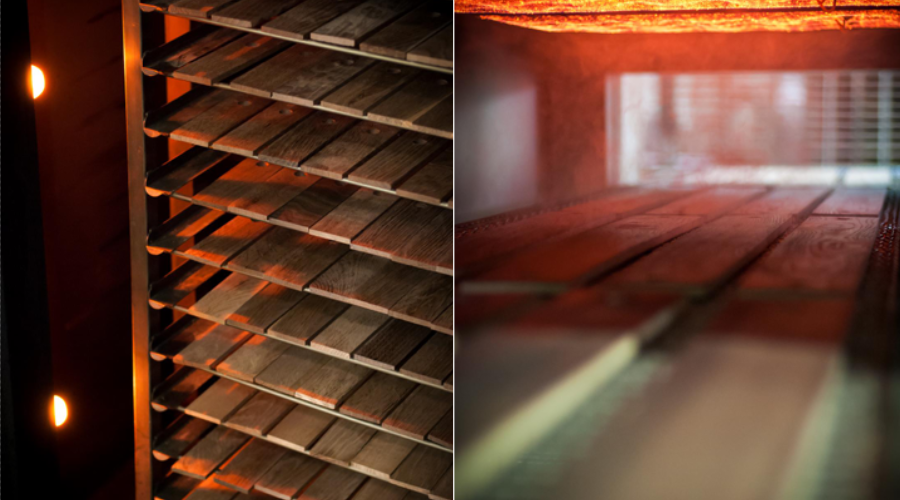
Image: Method of applying heat.
What are some of the most common mistakes wineries make when implementing alternative oak programs?
The most frequent mistakes are over-applying oak, tasting the treated wine too early, and not increasing the frequency of topping and SO2 additions.
As mentioned before, if someone prefers 40% New Oak and they interpret that as 40%NBE, that may unfortunately result in much more than the desired impact. The recommended ceiling dosage for Nobile Oak is 20%NBE for a “full strength” comparison to a new traditional barrel.
If you are unsure about dosages, use less oak. We can always add more later.
In tasting evaluations after applications, winemakers cannot help themselves. If we add something, we want to taste it to ensure it is doing the thing we want. Wine initially extracts furfural from oak, then over a longer timespan, steadily extracts lactones, eugenol, and ellagitannin.
The problem is that adjuncts are more rapidly extractable but still need time to harmonize. Initially, the wine tastes overly woody, disjointed, or planky during the peak extraction window before the wood and wine have integrated during the harmonization phase.
When considering an evaluation of barrels, nine months tends to be the ideal intersection of extraction and harmonization. While adjuncts extract faster, and thicker adjuncts have the potential for longer aging, they still require time in the harmonization curve before evaluation.
Regardless of thickness, I estimate an ideal time for evaluation of Through-Bung Inserts and Staves to be around 6-9 months, Blocks around 2-4 months, and Chips 4-6 weeks. This allows enough time for extraction and harmonization to occur.
Lastly, many programs maintain the same frequency of topping and SO2 additions as part of a cellar strategy. Staves, in a traditional barrel, soak up a moderate amount of wine into the staves until they reach saturation, increasing the ullage.
With adjuncts, whether in barrel or tank, the same saturation occurs. In a tank, the oak should be secured to the bottom, but in a barrel, any additional ullage could result in the adjunct breaching the surface of the wine, where bacteria can then grow.
Oak provides ellagitannin, which is helpful in antioxidative strategies, but also initially provides oxygen into the wine. As the oxygen interacts with other compounds, our FSO2 becomes bound, limiting the protection against spoilage organisms.
We recommend that winemakers ensure tank installations are secured below the surface of the wine, and SO2 is checked more frequently in aging, with inert gas in the headspace.
For through bung inserts in barrels, we recommend initially increasing the frequency of topping and SO2 additions to the alternative oak treated barrels.
For wineries considering reducing barrel dependence, where should they start and what should they evaluate first?
Do not overhaul your entire cellar overnight. Start with a rigorous cellar audit and bench trials.
Evaluate your current barrel inventory, isolate the sensory profiles those producers are delivering, and determine how integral they are to a particular program.
Next, pull representative samples of oaked (by traditional barrel) and unoaked base wine to set up a controlled, comparative trial using a standard 20% NBE dosage of an alternative foundational profile. For Nobile Oak, look at our Barrel Complexity profiles.
Benchmark the side-by-side against your traditional barrel controls. Evaluate not just the aroma and structure of the wine, but the labor logs, the cash flow tying up that lot, and the footprints required in the cellar.
In the evaluation during a blind tasting, we can begin to see sensory commonalities between the traditional barrel and the premium adjunct. The economics will begin to tell a different story, enabling wine producers to see exactly where they can maximize their barrel programs and cellar efficiency by introducing premium adjuncts.
[[relatedPurchasesItems-71]]
Looking ahead, how do you see oak management and wine style development evolving over the next 3–5 years?
We are moving rapidly away from the era of recipe winemaking and entering the era of oak engineering. Over the next few years, we look towards the line of distinction between a traditional barrel and a premium alternative will be negligible in the minds of winemakers.
As climate volatility forces us to deal with more frequent vintage extremes, oak management is estimated to become hyper-targeted and prophylactic. Economically, it is difficult to tie up cash so early in the year, especially before fruit set and harvest forecasting. We believe winemakers are going to demand more flexibility to be able to react to the needs of a vintage.
Many winemakers are beginning to adopt advanced techniques to neutralize vintage deficiencies right at the fermenter or early aging stage. With the further adoption of these techniques, we aim for the conversation to change from the prestige of the vessel, "How many months on oak?", to “Where is the focus and action of the oak?”
Those wineries that master this deconstructed blending approach as the ones that will be able to scale sustainably in the face of volatility.
About Jon Frost
Jon Frost (WSET Diploma, MBA) has worked in the wine industry since 2009, spanning roles from the cellar floor to technical leadership. Since 2022, he has served as Principal Specialist for NOBILE as part of LAFFORT USA across North America, where he partners with winemaking teams to develop targeted oak strategies that optimize wine style, consistency, and cellar efficiency. His expertise includes oak integration, alternative oak technologies, palate mapping, and helping wineries balance quality, consistency, and commercial performance across premium, bulk, and private label wine programs.
Also Read:
Logistics Isn't Just About Moving Wine. It's About Protecting Margins.
Beyond the Bottle: How Smart Packaging and Closures Protect Quality and Improve Profitability
'Relationships Win Bulk Spirits Deals': Bill Auxier on What Suppliers Need to Know
If you're a bulk wine or bulk spirits supplier, contract bottler, or private label producer aiming to connect with serious trade buyers, IBWSS San Francisco is the event you can't afford to miss. Get a quotation or book an exhibitor table.